

persolog® Model organizacijske otpornosti
Change, crises and unexpected challenges are part of everyday life for organizations. The persolog® Organizational Resilience Model helps to make organizational resilience visible and develop it further. It focuses on nine factors that influence an organization’s resilience and adaptability.
What is organizational resilience?
Organizational resilience describes an organization’s ability to deal with change, crises and unexpected challenges, remain capable of acting and adapt to new conditions. It is not only about overcoming difficult situations. Resilient organizations recognize changes in their environment, respond to them and learn from their experiences.
Organizational resilience is more than personal resilience and team resilience.
Personal resilience, team resilience and organizational resilience focus on different levels of resilience. Personal resilience focuses on the individual, team resilience on how a team deals with challenges together and organizational resilience on the organization as a whole.
Resilient employees and teams can contribute to the resilience of an organization. However, this does not automatically make the organization resilient. At the organizational level, additional factors such as leadership, culture, market relationships, resources, knowledge sharing and the ability to change play an important role.
What is the persolog® Organizational Resilience Model?
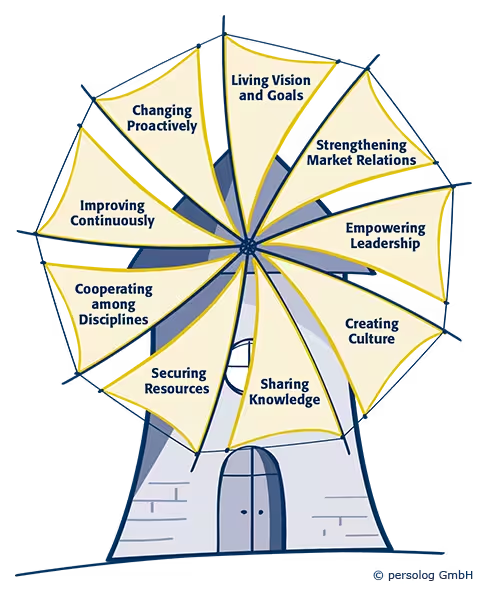
The persolog® Organizational Resilience Model helps to take a closer look at an organization’s resilience and adaptability. It shows how an organization is positioned across different areas of organizational resilience.
The model is aligned with ISO 22316 “Security and resilience – Organizational resilience – Principles and attributes”. It describes key principles and attributes of organizational resilience. Based on this ISO standard, we defined the nine factors of the persolog® Organizational Resilience Model and developed a questionnaire that can be used to assess and reflect on an organization’s resilience.
The 9 factors of the persolog® Organizational Resilience Model
The nine factors cover different areas of an organization, from vision and goals to leadership and culture as well as knowledge, resources and dealing with change.

1. Living vision and goals
Living vision and goals means that an organization has a clear idea of its future and that this vision provides direction in everyday work. What matters is that the vision and goals are not only defined but are also understood by employees and reflected in their daily actions.

2. Strengthening market relations
Strengthening market relationships means recognizing relevant developments in the organization’s environment and maintaining relationships with important external partners and stakeholders. This can help identify changes, opportunities and potential challenges at an early stage and take them into account when making decisions.

3. Empowering leadership
Empowering leadership creates conditions in which employees can take responsibility and contribute their skills. This includes providing direction while allowing room for independent action so that employees can remain capable of acting even during periods of change and uncertainty.

4. Creating culture
A culture that supports resilience influences how people within an organization work together and deal with change. Shared values, trust and a constructive approach to working together can help ensure that challenges are addressed openly and dealt with collectively.

5. Sharing knowledge
Sharing knowledge means making relevant knowledge accessible within the organization and encouraging exchange between employees and departments. This prevents important knowledge from remaining with individual people and allows it to be used in new or challenging situations.

6. Securing resources
Securing resources means creating the conditions an organization needs to fulfil its tasks and deal with challenges. This includes keeping track of available resources and using them where they are needed.

7. Cooperating among disciplines
Interdisciplinary collaboration brings together different perspectives, skills and experiences within an organization. When departments and functions work together across boundaries, complex challenges can be considered and addressed jointly.

8. Improving continuously
Continuous improvement means regularly reviewing existing processes and ways of working and learning from experience. Insights gained from successes, mistakes and challenges can be used to adapt processes and develop the organization further.

9. Changing proactively
Proactive change means not approaching change solely as a reaction to external pressure. Developments and potential challenges are recognized early so that the organization can actively shape change and adapt to new conditions.
Where is the persolog® Organizational Resilience Model used?
The persolog® Organizational Resilience Model can be used in different situations where organizations want to reflect on and develop their resilience and adaptability. It can be applied in organizational development, change processes and in the work of leaders, HR professionals, trainers, coaches and consultants.
Organizational development
In organizational development, the model helps to take a closer look at different areas of organizational resilience. This can reveal topics that are particularly relevant for the organization’s further development.
Change management and transformation
Change and transformation processes create new demands for organizations. The model can support organizations in examining how they deal with change, where good conditions are already in place and which areas require more attention.
Leadership and personnel development
Leadership and personnel development influence the conditions under which employees deal with change and challenges. The model makes it possible to examine these conditions at an organizational level and identify topics for further development.
Crises and challenging situations
Crises and periods of high uncertainty often reveal where organizations are resilient and where difficulties arise. The model can be used to reflect on these experiences and gain insights for dealing with future challenges.
Training, coaching and consulting
Trainers, coaches and consultants can use the persolog® Organizational Resilience Model to support organizations in reflecting on their organizational resilience. The nine factors provide orientation for workshops, coaching sessions and other development measures.
How is the persolog® Organizational Resilience Model applied in practice?
The persolog® Organizational Resilience Profile can be used to assess how organizational resilience is perceived across the nine factors. It is based on a questionnaire whose results show where an organization is already well positioned and where there is potential for further development.
For a shared perspective, the results can be brought together in the persolog® Resilience Organization Chart. This makes different perspectives within the organization visible so they can be reflected on together.
Based on the results, relevant areas for action can be identified and appropriate measures can be developed. Depending on the objective, the model can be used in workshops, coaching sessions or surveys within teams and organizations.
Work professionally with the persolog® Organizational Resilience Model
If you want to use the persolog® Organizational Resilience Model professionally in training, coaching or organizational development, you can become certified in the model. During the certification, you learn about the nine factors of organizational resilience and how to work with the persolog® Resilience Organization Profile and the Resilience Organization Chart.
Who is the certification suitable for?
The certification is designed for people who professionally support and develop organizations. This includes trainers, coaches, consultants, leaders and professionals working in HR, personnel development and organizational development.
Što kažu naši kupci
Oduševljen sam načinom na koji se prenosi sadržaj treninga o organizacijskoj otpornosti. Materijali su zreli. Video sadržaj je visoko profesionalan. Zbog toga mi se trenerski horizont znatno proširio.
Udo Kollodzinski
Owner Udokollo - consulting & coaching
Anyone who registers for the online certification "Organizational Resilience" can look forward to an exciting, very well-structured and extremely diverse learning package! The instructional videos are understandable and entertaining, the exercises are very well explained and perfectly implementable thanks to the extensive work material. The expert interviews round off the topic and the live sessions offer a good opportunity to ask questions that arise. But also the support during the online learning is super: every question and comment was immediately answered competently. In addition, the platform Slack offers a great opportunity to network and exchange with other participants. Persolog has once again put together something great.
Christina Matt, trenerica i trenerica
Frequently asked questions about organizational resilience
What is the difference between personal resilience, team resilience and organizational resilience?
The three terms look at resilience on different levels. Personal resilience focuses on the individual, team resilience on the shared resilience and adaptability of a team and organizational resilience on the organization as a whole. At the organizational level, aspects such as structures, leadership, culture and resources also play an important role.
What is the difference between organizational resilience and crisis management?
Crisis management primarily focuses on preparing for and dealing with specific crisis situations while organizational resilience takes a broader perspective. Organizational resilience looks at how an organization remains capable of acting and adapting in the face of change and unexpected challenges. Crisis management can be an important part of a resilient organization but it is not the same as organizational resilience.
What role does leadership play in organizational resilience?
Leadership has a significant influence on how an organization deals with change and challenges. Leaders can provide direction, enable employees to take responsibility and create conditions in which they can contribute their skills. The persolog® Organizational Resilience Model addresses this aspect through the factor “Empowering Leadership”.
Is an organization resilient if its employees are resilient?
Resilient employees can contribute to organizational resilience but they do not automatically make an organization resilient. Organizational conditions such as leadership, culture, structures, resources, knowledge and the ability to change also play an important role. Personal resilience and organizational resilience therefore focus on different levels even though they are connected.