

persolog® CORE SIX: The 6-Factor Personality Model
The persolog® CORE SIX model describes core personality through six dimensions: Honesty & Humility, Emotionality, Extraversion, Agreeableness, Conscientiousness, and Openness to Experience. CORE SIX is based on the internationally established HEXACO model of personality.
The model provides a differentiated view of more stable personality traits, individual strengths, areas of tension and potential areas for development. These insights can be used as a basis for self-reflection and personal or professional development.
What is the persolog® CORE SIX model?
The persolog® CORE SIX model is a 6-factor personality model for gaining a differentiated understanding of core personality. It is based on the HEXACO model and considers six fundamental personality dimensions that provide a structured way to describe individual differences in personality.
CORE SIX does not assign people to fixed personality types. Instead, it considers the individual expression of the six factors and their underlying facets. This creates a differentiated picture of core personality that makes individual differences visible and provides a basis for reflection and development.
CORE SIX focuses on more stable personality traits that contribute to recurring patterns in how people experience situations and behave. This makes it possible to reflect not only on individual behaviors, but also on underlying personal patterns.
The six personality factors of the CORE SIX model
The persolog® CORE SIX model describes core personality through six overarching personality factors. Each factor consists of different facets and can vary in its individual expression. What matters is not assigning someone to a particular personality type, but understanding the interaction between the six factors and their individual expressions.

Honesty & Humility
Honesty & Humility describes, among other things, how people approach fairness, status, personal advantage and rules. The factor provides insights into a person’s tendency to act sincerely and fairly, seek privileges for themselves or place greater importance on their own status.

Emotionality
Emotionality describes how people experience emotional strain, uncertainty and risk, as well as the extent to which they seek emotional support and connection with others. Different expressions can be reflected, for example, in how sensitively a person responds to stressful situations and how they deal with worry or fear.

Extraversion
Extraversion describes, among other things, how confident and comfortable people feel in social interactions, how actively they approach others and the extent to which they experience positive energy and enthusiasm. The factor therefore considers different aspects of experience and behavior in social situations.

Agreeableness
Agreeableness describes how people deal with disagreements, anger and interpersonal tension. The factor provides insights into how forgiving, willing to compromise and patient a person tends to be when interacting with others.

Conscientiousness
Conscientiousness describes how structured, careful and goal-oriented people are in their approach to tasks. This includes aspects such as planning and organization, accuracy and the willingness to invest effort in achieving goals.

Openness to Experience
Openness to Experience describes a person’s willingness to engage with new ideas, perspectives and experiences. The factor includes aspects such as curiosity, creativity, interest in unconventional ideas and openness to new impressions and perspectives.
What is the scientific foundation of CORE SIX?
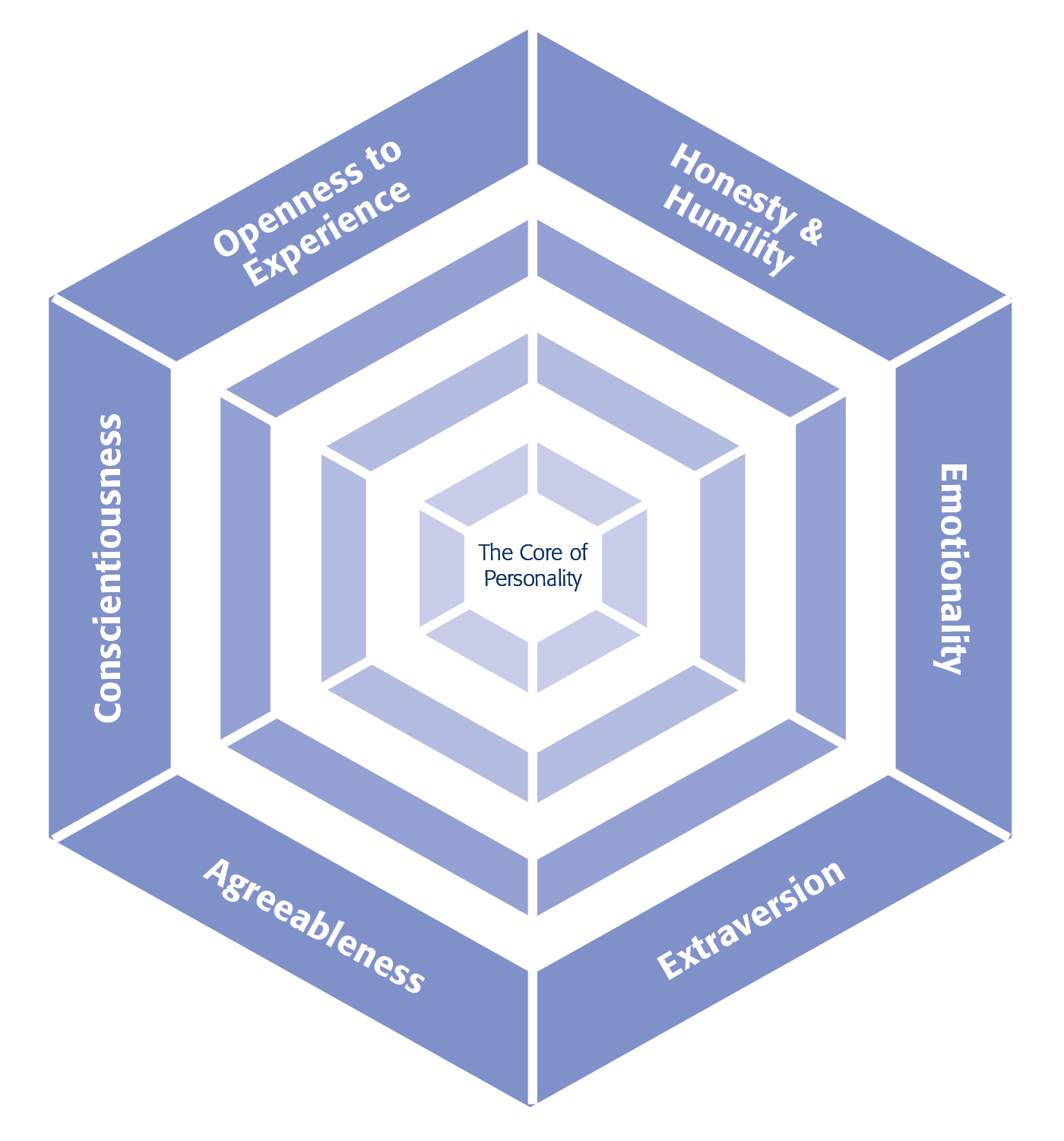
The persolog® CORE SIX model is based on the HEXACO model of personality, a scientific advancement of the Big Five model. HEXACO expands the five well-known personality factors by adding a sixth factor: Honesty & Humility. This allows the model to additionally consider aspects such as sincerity, fairness and the way people deal with status and personal advantage.
The HEXACO model is based on international personality research. Cross-language studies of personality structure have shown that personality can be described in a more differentiated way using six rather than only five overarching factors. HEXACO therefore represents a scientifically grounded advancement of the traditional five-factor approach.
What is the difference between core personality and situational behavior?
Situational behavior describes how a person behaves in a particular situation, while core personality refers to more stable personality traits that contribute to recurring patterns. Both levels provide different perspectives on why people respond differently to certain situations.
The persolog® Personfaktormodell, with its four behavioral dimensions Dominant, Influencing, Steady and Cautious, primarily focuses on situational behavior. The persolog® CORE SIX model goes one level deeper and uses six personality factors to examine more stable characteristics of core personality.
CORE SIX and the persolog® Personality Factor Model complement each other
The two models address different questions. The persolog® Personfaktormodell helps you understand and reflect on behavior in specific situations. CORE SIX helps you take a differentiated look at more stable personality traits and recurring patterns.
Combining both perspectives can provide a more comprehensive understanding: How does behavior show up in a particular situation and which more stable personality traits may contribute to recurring patterns?
Where is the persolog® CORE SIX model used?
The persolog® CORE SIX model is suitable for contexts where a differentiated understanding of core personality, recurring patterns and individual development is valuable. Key areas of application include coaching, leadership development, personnel and talent development, team development and personal development.
Coaching and executive coaching
In coaching, CORE SIX helps to examine more stable personality traits and recurring patterns in a differentiated way. Coaches can use these insights together with their coachees to understand personal patterns and derive specific development goals.
Leadership and leadership development
CORE SIX helps leaders reflect more consciously on their own core personality and recurring patterns in their day-to-day leadership. The six personality factors can help them better understand their own patterns of reaction and decision-making and take a differentiated look at personal areas for development.
Personnel and talent development
In personnel and talent development, CORE SIX complements the focus on competencies and observable behavior by adding the perspective of more stable personality traits. This can help professionals take a more differentiated view of individual development needs and reflect on development measures more specifically.
Team development and teamwork
Within teams, different personality traits can influence how people communicate, make decisions or deal with tension. CORE SIX provides a common language for better understanding these differences and discussing them constructively within the team.
Personal development
CORE SIX gives you a differentiated view of your own core personality. Exploring the six personality factors can help you become more aware of your strengths, recurring patterns, areas of tension and potential areas for development and use these insights to define realistic development goals.
Recruiting and personnel selection
In recruiting, CORE SIX can provide an additional perspective on personality and potential fit. The six personality factors can help professionals reflect on relevant personality traits in a structured way and consider them in the context of a particular role or organization. CORE SIX should be understood as one component of a broader selection process.
How is the persolog® CORE SIX model applied in practice?
A range of assessment, reflection, coaching and training tools are available for working with CORE SIX in practice. They support a differentiated exploration of the six personality factors and their facets and help transfer the resulting insights to specific development questions.
A central foundation is the CORE SIX 6-Factor Personality Profile. It provides a structured way to explore the individual expression of the six personality factors and their facets. Additional tools support the further use of these insights in different coaching, training and development contexts.
The focus is not only on interpreting a profile but also on transferring insights into practice. Exploring your core personality can therefore lead to specific questions and starting points for further development.
Work professionally with the persolog® CORE SIX model
If you want to use CORE SIX professionally in coaching, training, leadership development or personnel development, you can become certified in the model. During the CORE SIX certification, you learn how to interpret the six personality factors and their facets and how to use the 6-Factor Personality Profile responsibly in your professional work.
The certification provides you with the knowledge required to apply CORE SIX professionally and responsibly. You learn how to interpret profiles in a well-founded way, discuss results professionally and integrate CORE SIX confidently into your specific area of work.
Who is the CORE SIX certification for?
The certification is designed for professionals who work with personality and development. This includes coaches, trainers, leaders and professionals working in HR, personnel development, and Learning & Development.
What can you do with CORE SIX after completing the certification?
After completing the certification, you can use the persolog® CORE SIX model and its associated tools professionally in your work. You can interpret personality profiles, facilitate reflection and development processes and use CORE SIX in contexts such as coaching, training, personnel development and leadership development.
Frequently asked questions about the persolog® CORE SIX model
What is the difference between HEXACO and the Big Five?
HEXACO is a scientific advancement of the Big Five model and considers six rather than five overarching personality factors. The additional sixth factor is Honesty & Humility, which covers aspects such as sincerity, fairness and the way people deal with status and personal advantage. This allows HEXACO to provide a more differentiated view of core personality.
Is a person’s core personality unchangeable?
No. Core personality should not be understood as an unchangeable definition of a person. CORE SIX examines more stable personality traits that contribute to recurring patterns and are less influenced by individual situations. Reflecting on these traits can help you become more aware of personal patterns and identify potential areas for development.
Is CORE SIX a personality test?
No. CORE SIX is a 6-factor personality model that provides a framework for examining and reflecting on core personality in a differentiated way. The corresponding 6-Factor Personality Profile assesses the individual expression of the six personality factors and their facets, providing a structured basis for reflection and development.
What do high or low scores on the six CORE SIX factors mean?
High or low scores describe how strongly certain personality traits are expressed in a person and do not represent a positive or negative evaluation in themselves. Their meaning depends on the respective factor, its facets and the individual context. Individual scores should therefore not be considered in isolation but interpreted within the overall personality profile.
Why does CORE SIX consider individual facets in addition to the six factors?
The facets provide a more differentiated understanding of how an overarching personality factor is individually composed. Two people can have a similar overall expression of a factor while still differing in individual facets. This makes it possible to reflect more precisely on individual differences and potential areas for development.
Why is it not enough to consider only one CORE SIX factor?
The six CORE SIX factors should not be viewed in isolation because an individual personality profile emerges from the interaction between the factors and their underlying facets. Individual expressions gain meaning within the context of the overall profile and the specific question being explored. A differentiated perspective therefore helps prevent premature conclusions based on individual scores.
How can CORE SIX support personal development?
CORE SIX can support personal development by helping you reflect on more stable personality traits and recurring patterns. The results can help you better understand individual strengths and areas of tension and derive specific development questions. The model does not prescribe a particular direction for development but provides a structured basis for a differentiated exploration of your own personality.