

persolog® Team Resilience Model
The persolog® Team Resilience Model helps teams better understand and develop their team resilience. At the heart of the model are six team resilience factors. They show what strengthens a team in difficult situations and where there is room for development. This makes it easier to understand what teams need to work well together even when facing change, pressure and setbacks.
What is team resilience?
Team resilience becomes particularly visible when things get difficult: when familiar processes no longer work, uncertainty arises or pressure increases. What matters then is how the team works together: How do team members overcome challenges together, how do they respond to setbacks and how does the team manage to realign itself?
Team resilience is more than the resilience of individual team members.
A team does not automatically become resilient simply because its individual members have a high level of personal resilience. Team resilience emerges from how people interact and work together and is influenced, among other things, by how a team communicates, collaborates, makes decisions and deals with mistakes or uncertainty.
Personal resilience and team resilience are therefore connected, but they focus on different levels. While the persolog® Personlig Resiliensmodell focuses on the resilience of the individual, the persolog® Team Resilience Model looks at the team as a whole and its collective ability to withstand challenges and adapt to change.
What is the persolog® Team Resilience Model?
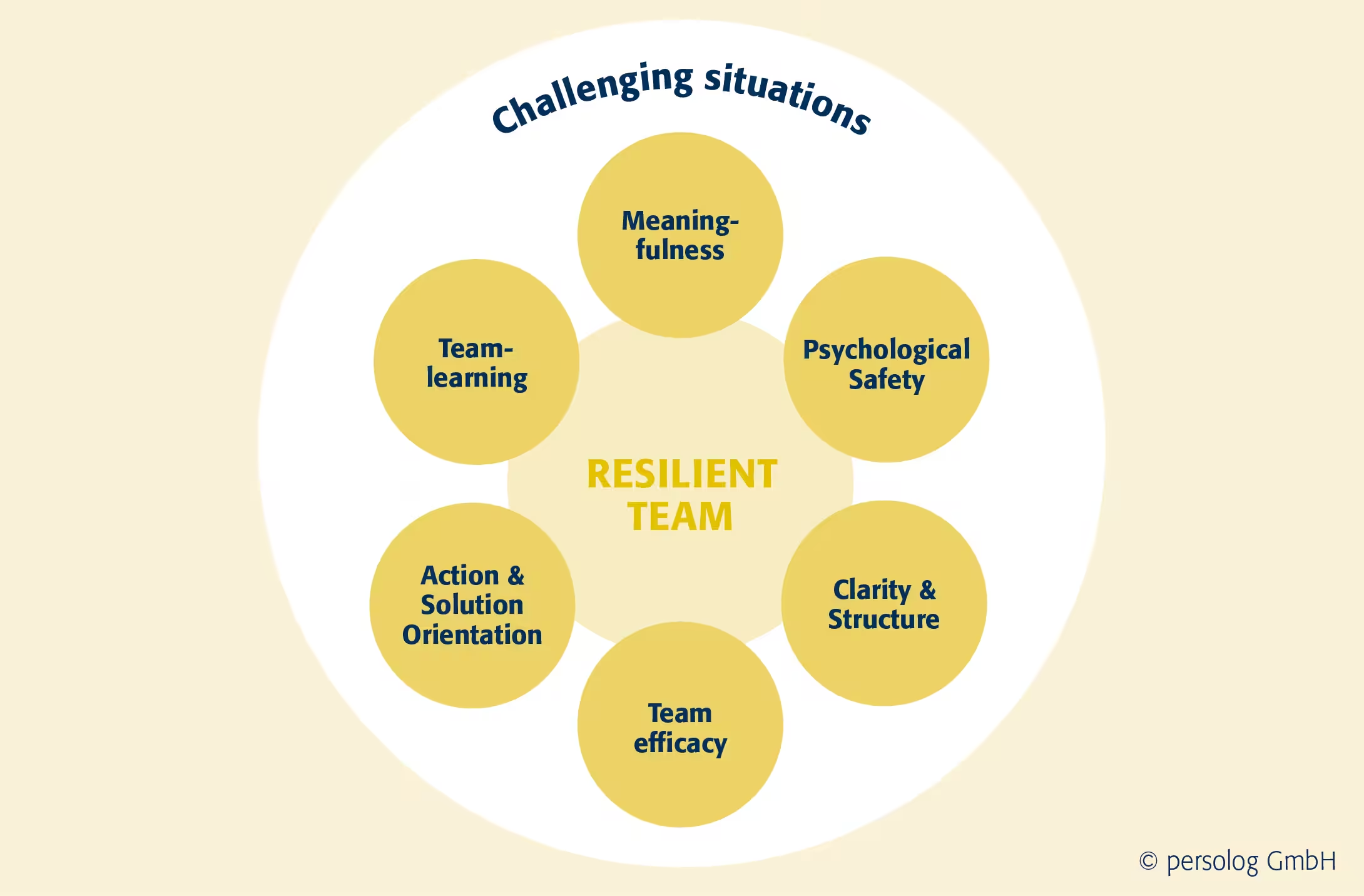
The persolog® Team Resilience Model shows what makes a team resilient and where there is room for development. It does not focus on the resilience of individual team members, but on the team as a whole and on how its members work together and overcome challenges.
At the heart of the model are six team resilience factors that represent important aspects of teamwork. The aim is not to classify a team as “resilient” or “not resilient.” Instead, the model helps teams reflect on how they work together, recognize where they are already doing well and identify areas they can work on together.
The 6 factors of the persolog® Team Resilience Model
The persolog® Team Resilience Model considers six factors that are relevant to a team’s resilience: Meaningfulness, Psychological Safety, Team Efficacy, Clarity & Structure, Action & Solution Orientation and Team Learning. Together, they provide a differentiated view of how a team deals with challenges and where there are opportunities for further development.
Meaningfulness
Meaningfulness describes the extent to which team members recognize a sense of purpose in their shared work and understand what they are working toward as a team.
A shared sense of purpose and meaning can provide direction and help the team remain focused on common goals even in challenging situations.
Psychological Safety
Psychological Safety describes a team climate in which team members feel able to ask questions, contribute ideas, raise concerns and openly address mistakes.
Especially in difficult or uncertain situations, this openness is important so that relevant information is not withheld and challenges can be addressed together.
Team Efficacy
Team Efficacy describes a team’s shared belief that it can overcome challenges using the skills and resources available to it.
It strengthens confidence in the team’s collective ability to take action and can encourage team members to actively look for solutions even when difficulties arise.
Clarity & Structure
Clarity & Structure describe how clearly roles, responsibilities, goals and processes are defined within a team.
Especially under pressure, clear structures can provide direction and help a team remain capable of taking action without losing sight of responsibilities.
Action & Solution Orientation
Action & Solution Orientation describes a team’s ability to actively address challenges and focus on possible solutions and next steps.
Instead of remaining focused on the problem, the team develops possible courses of action together and puts them into practice.
Team Learning
Team Learning describes a team’s ability to learn collectively from experiences, successes, mistakes and setbacks.
Insights are reflected on and used to improve future collaboration, allowing the team to develop based on shared experiences.
How can team resilience be developed?
Team resilience does not develop overnight, but through a shared process. Teams can systematically reflect on their collaboration and the way they deal with challenges and develop these areas step by step.
In the persolog® Team Resilience Model, this development process is described through four steps: Anticipating, Securing, Shaping and Learning. They focus on how teams prepare for challenges, secure their resources, actively shape difficult situations and subsequently learn from their experiences.
Anticipating means identifying potential challenges and changes at an early stage. Securing focuses on maintaining important resources and conditions for effective collaboration. Shaping means actively addressing challenges together and dealing with them using the resources available to the team. Learning helps the team reflect on its experiences and use the insights gained in future situations.
The six team resilience factors show where a team can start when it wants to develop its resilience.
Where is the persolog® Team Resilience Model used?
The persolog® Team Resilience Model can be used in different situations where teams want to reflect on how they work together and strengthen their resilience. It can be used directly in team development as well as by leaders, trainers and coaches who support teams.
Team development
In team development, the model helps teams go beyond a general assessment of their collaboration and identify specific starting points for developing team resilience. Teams can reflect together on what already strengthens them and where changes may be beneficial.
Leadership and team management
Leaders and team managers can use the model to better understand which conditions support their teams in dealing with stress and change. This makes it easier to address development needs and derive shared measures for improving collaboration.
Coaching and training
For trainers and coaches, the persolog® Team Resilience Model provides a structured framework for supporting teams. Insights from the model can be used as a starting point for defining development goals and systematically working on team resilience.
Change and crisis situations
Periods of change, uncertainty or high pressure often reveal how a team responds to new demands. The model can support teams in reflecting on challenges together, maintaining their ability to take action and using insights from difficult situations to improve future collaboration.
Companies and organizations
Team resilience can contribute to how organizations deal with change and challenges. The persolog® Team Resilience Model can therefore be integrated into team, leadership and personnel development initiatives, for example.
The focus remains on the resilience of individual teams: Team resilience can contribute to organizational resilience, but it is not the same as organizational resilience.
How is the persolog® Team Resilience Model applied in practice?
An important part of working with the model in practice is the persolog® Team Resilience Profile. Using a questionnaire, team members assess the resilience of their team. The results show how the six team resilience factors are perceived within the team.
Team members receive an individual evaluation as well as an evaluation at team level. This also reveals differences in how team members perceive their team. The team can see where it is already doing well and where there is room for development.
The results are not intended to classify a team as “resilient” or “not resilient.” Instead, they help team members start a conversation, prioritize areas for development and define concrete next steps for working together.
Work professionally with the persolog® Team Resilience Model
If you want to use the persolog® Team Resilience Model professionally in training, coaching or team development, you can become certified in the model. During the Team Resilience Certification, you learn about the six team resilience factors, work with the persolog® Team Resilience Profile and learn how to evaluate the results and use them to support team development.
Who is the Team Resilience Certification for?
The certification is designed for people who professionally support and develop teams. This includes trainers, coaches, leaders, team managers and professionals working in HR and personnel development who want to integrate team resilience into their existing work.
What can you do with the Team Resilience Model after completing the certification?
After completing the certification, you can use the persolog® Team Resilience Model and its associated tools professionally in your work. You can evaluate the Team Resilience Profile, reflect on the results together with teams and facilitate development processes, for example in team development, training or coaching.
Hva våre kunder sier
My certification Team Resilience: Absolutely worthwhile! With Debora as a competent seminar leader, we participants have the opportunity to intensively learn together about, discuss and apply the exciting content on team resilience. A brilliant group meets brilliant topics. Team resilience now completes the resilience package at persolog. It doesn't get any better than this. Thank you!
Isabelle Weyand
As a cultural developer and coach, the model gives me many opportunities to specifically support and strengthen teams in their development. It has a clear structure, is easy to understand and has a large repertoire of practical exercises and methods. From my point of view it´s very successful!
Helmut Martin
I am delighted with the way the content of the training is conveyed. The materials are mature. The video content is highly professional. My coaching horizons have expanded greatly as a result.
Udo Kollodzinski
Frequently asked questions about the persolog® Team Resilience Model
What is the difference between personal resilience and team resilience?
Personal resilience focuses on how an individual deals with stress, change and challenges. Team resilience, on the other hand, focuses on the team as a whole and on how its members deal with difficult situations together and remain capable of taking action. A team is therefore not automatically resilient simply because its individual members have a high level of personal resilience.
How can you recognize a resilient team?
A resilient team is not defined by the absence of conflict, setbacks or stress. Instead, the team is able to remain capable of taking action under challenging conditions, adapt to changing circumstances and learn from shared experiences. The six factors of the persolog® Team Resilience Model provide a structured framework for taking a differentiated look at team resilience.
What role do leaders play in developing team resilience?
Leaders can influence the conditions under which team resilience develops. This includes how mistakes and uncertainty are handled, how clearly goals and responsibilities are defined and how communication and collective learning are encouraged. However, team resilience is not the sole responsibility of the leader; it emerges through the interaction of the entire team.
Can a team remain resilient under high levels of stress?
High levels of stress do not necessarily prevent a team from being resilient. What matters is not whether a team can avoid stress or setbacks, but how it deals with them collectively, uses available resources and adapts its collaboration to changing conditions. Resilient teams can still reach their limits and may require additional support.
What is the difference between team resilience and organizational resilience?
Team resilience focuses on the resilience and adaptability of a team, while organizational resilience considers the organization as a whole. Resilient teams can contribute to the resilience of an organization, but team resilience and organizational resilience are not the same.
Do I need a certification to work professionally with the persolog® Team Resilience Model?
If you want to use the persolog® Team Resilience Model, the Team Resilience Profile and its associated tools professionally in training, coaching or team development, the relevant qualification is important for professional application. During the certification, you learn how to interpret the model and its results and how to support development processes with teams.