
persolog® Personal Resilience Model
The persolog® Personal Resilience Model helps you understand your personal resilience and develop it systematically. It focuses on four areas of personal resilience: Accepting, Feeling, Gaining Orientation and Understanding. These four areas comprise a total of ten resilience factors that describe different aspects of how people deal with stress, change and challenges.
The model provides a structured framework for reflecting on your own resilience, identifying personal resources and areas for development and deriving specific starting points for strengthening your resilience.
What is resilience?
Resilience is the ability to deal with stress, crises, change and challenges and to adapt to changing circumstances. It does not mean going through difficult situations unaffected. Rather, it involves remaining capable of taking action despite adversity, making use of available resources and developing constructive ways of dealing with challenges.
Resilience is not a fixed trait that a person either has or does not have. It comprises different factors and competencies that can vary from person to person and can be further developed. This is where the persolog® Personal Resilience Model comes in.
Resilience does not mean always being strong.
Being resilient does not mean never experiencing stress, uncertainty or negative emotions. Challenging situations can affect resilient people, too. What matters is how people deal with these situations, which resources are available to them and how they regain a sense of direction and the ability to act after periods of adversity.
Resilience should therefore not be confused with simply persevering or enduring ever-increasing levels of stress. Recognizing your own limits, dealing consciously with emotions and seeking support can also be important aspects of responding resiliently to challenges.
What is the persolog® Personal Resilience Model?
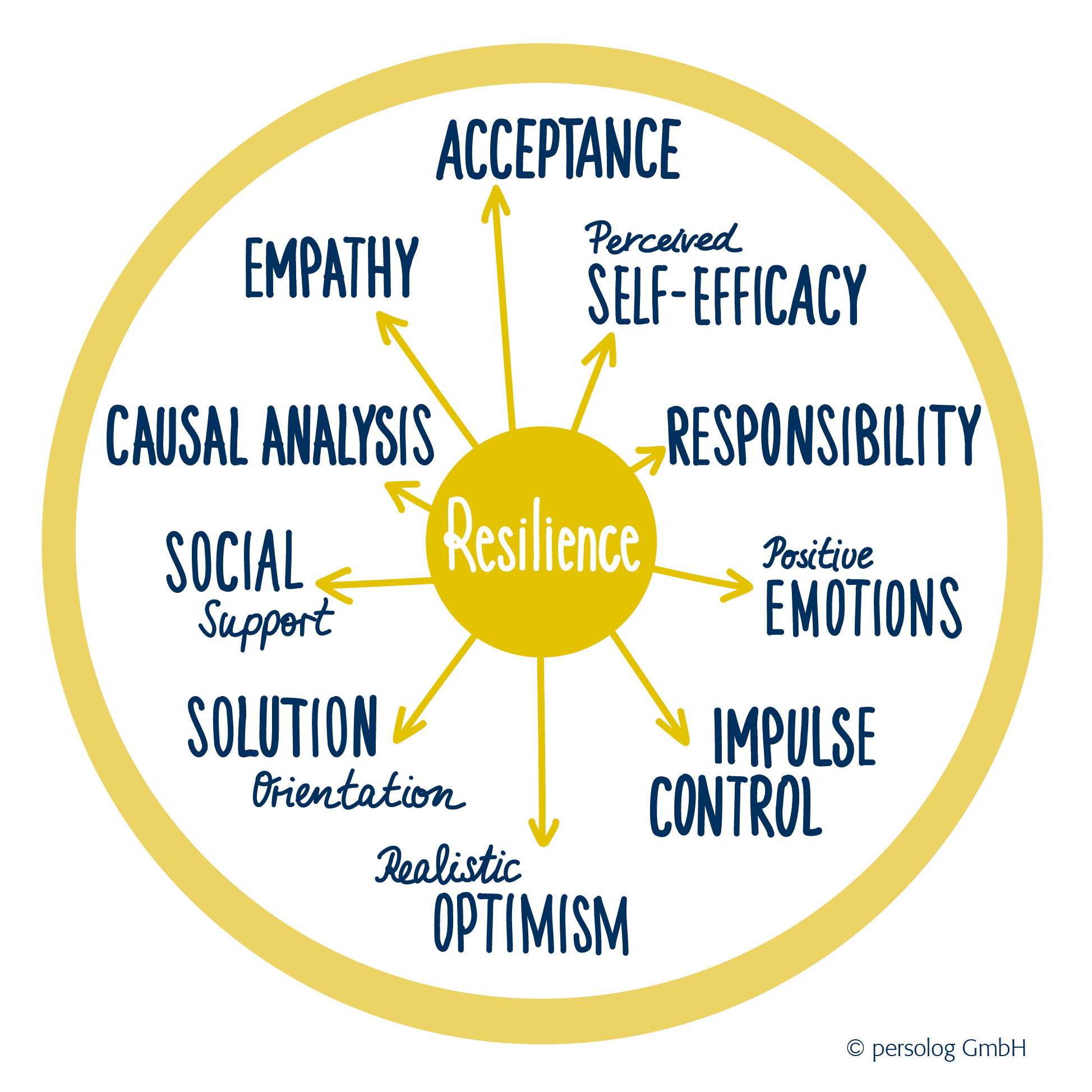
The persolog® Personal Resilience Model views resilience as a competency that can be developed. It provides a structured framework for exploring personal resilience and identifying individual starting points for further development.
The model considers ten resilience factors, which are grouped into the four overarching areas Accepting, Feeling, Gaining Orientation and Understanding. Together, they provide a comprehensive view of different aspects of personal resilience.
The aim is not to classify people as “resilient” or “not resilient.” Instead, the model helps identify individual strengths and areas for development within the different aspects of resilience and provides a basis for reflection and further development.
The 10 Resilience Factors of the persolog® Personal Resilience Model
1. Accepting – Accepting yourself and life as they are
The area of Accepting describes how people accept themselves and life, including both the aspects they can change and those they cannot. It includes the three resilience factors Acceptance, Responsibility and Perceived Self-Efficacy.
Acceptance
Acceptance means acknowledging what cannot or can no longer be changed. This may include past events as well as situations or the behavior of other people over which we have no direct influence. Acceptance can help shift the focus away from what cannot be changed and toward the options for action that remain available.
Responsibility
Responsibility describes the willingness to take responsibility for your own thoughts and actions. Not every situation can be influenced, but the way we deal with it often can. This factor therefore focuses on recognizing and consciously using your own scope for action.
Perceived Self-Efficacy
Perceived Self-Efficacy describes the belief that you can overcome challenges using your own abilities. Trusting in your own competence can make it easier to approach challenges actively rather than feeling entirely at their mercy.
2. Feeling – Dealing mindfully with emotions
The area of Feeling focuses on dealing mindfully with your own emotions. It includes the two resilience factors Positive Emotions and Impulse Control.
Positive Emotions
Positive emotions describe the ability to notice and allow positive feelings even in difficult situations. This does not mean suppressing negative emotions, but rather not allowing them to permanently take up all the emotional space and consciously strengthening access to positive emotions.
Impulse Control
Impulse control describes the ability to notice and question initial impulses before they turn into a reaction. This can make it easier to respond more consciously to triggers and manage your own behavior more deliberately, even in emotionally challenging situations.
3. Gaining Orientation – Finding direction and support
The area of Gaining Orientation describes how people find direction and make use of available support in challenging situations. It includes the three resilience factors Realistic Optimism, Solution Orientation and Social Support.
Realistic Optimism
Realistic optimism means recognizing positive possibilities without ignoring difficulties or risks. It involves a confident outlook on the future while still taking the actual circumstances of a situation into account.
Solution Orientation
Solution orientation focuses on possible courses of action and ways of addressing a problem. This includes considering different solutions, defining goals and anticipating potential obstacles rather than focusing solely on the problem itself.
Social Support
Social support describes the ability and opportunity to draw on reliable relationships in challenging situations. A reliable social network can provide support and help ensure that stress and challenges do not have to be dealt with entirely alone.
4. Understanding – Reflecting on behavior and questioning situations
The area of Understanding focuses on reflecting on behavior and examining situations and their possible causes from different perspectives. It includes the two resilience factors Causal Analysis and Empathy.
Causal Analysis
Causal analysis describes the ability to analyze difficult situations and consider different possible causes. This can help people better understand connections, identify recurring patterns and find starting points for dealing more consciously with similar situations in the future.
Empathy
Empathy describes the ability to perceive and understand the emotional state and needs of other people. This can help you better interpret other people’s reactions, respond appropriately and maintain constructive relationships even in challenging situations.
Where is the persolog® Personal Resilience Model used?
The persolog® Personal Resilience Model can be used wherever people want to reflect on and develop their personal resilience. It provides a structured framework for personal development as well as for professionally supporting people in coaching, training and workplace contexts.
Personal development
The model helps you take a closer look at your personal resilience. You can identify which resilience factors are already more strongly developed and which ones you would like to develop further. This can provide individual starting points for dealing with challenges and change.
Coaching and training
In coaching and training, the persolog® Personal Resilience Model provides a structured framework for reflecting on resilience together with participants or coachees. Rather than addressing resilience only as a general concept, individual resilience factors can be explored and used to derive specific development goals and actions.
Leadership and employee development
In the workplace, stress, change and uncertainty can place different demands on different people. The Personal Resilience Model can help leaders and employees become more aware of individual resources and areas for development and reflect on how they deal with challenging situations.
Teams and organizations
The personal resilience of individuals is also relevant in an organizational context. The persolog® Personal Resilience Model can therefore be used in development initiatives for employees and teams, for example when the aim is to strengthen constructive ways of dealing with change and challenging situations.
How is the persolog® Personal Resilience Model applied in practice?
Reflection, coaching and training tools are available for applying the persolog® Personal Resilience Model in practice. They support a structured exploration of personal resilience and help make the resulting insights useful for further development.
A central foundation is the persolog® Resilience Profile. It shows the individual expression of the ten resilience factors and provides a structured basis for exploring your own resilience competencies. The aim is not to evaluate someone as “resilient” or “not resilient,” but to identify and understand individual expressions of the different factors.
The results can then serve as a starting point for reflection, coaching, training and personal development processes. Additional tools and methods help transfer insights from the profile to specific situations and support individual development.
Work professionally with the persolog® Personal Resilience Model
If you want to use the persolog® Personal Resilience Model professionally in training, coaching or personnel development, you can become certified in the model. During the Resilience Certification, you learn how to interpret the ten resilience factors and use the persolog® Resilience Profile professionally and responsibly.
The certification provides you with the knowledge and methodological skills required to apply the model professionally. You learn how to evaluate the Resilience Profile, discuss results appropriately and integrate the model into your own training, coaching or development contexts.
Who is the Resilience Certification for?
The certification is designed for people who professionally support others in their development. This includes trainers, coaches, leaders and professionals working in HR and personnel development who want to integrate resilience into their existing work.
What can you do with the Resilience Model after completing the certification?
After completing the certification, you can use the persolog® Personal Resilience Model and its associated tools professionally in your work. You can evaluate the Resilience Profile, facilitate reflection and development processes and use the model in contexts such as training, coaching and personnel development.
What our customers say
Resilience is an integral part of our daily life and a very interesting topic. In my search for a suitable certification, I came across persolog®. This was the best decision. Why? I now have the knowledge I need about resilience and, in addition, a practical tool. With it, I can offer the topic of resilience to my clients in a way that is understandable, clear and applicable to their needs.
Nancy Matzke
Recognizing and developing one's own resilience competence means building up and expanding resistance in times of crisis. Because the difference is who gets up again after difficult times in life! This is exactly what I learned in Debora's seminar - with many tools, methods and aha-moments. After the seminar, I had clarity about my behavior and why I am like this and how I behave! Exactly the right seminar for all who want to know how to create a change in your behavior to achieve different results! I am looking forward to the continuation of the seminar in July with Debora.
Bettina Schell
Resilience Certification Digital I took the resilience certification online and loved it! Debora was able to convey the knowledge in a very clear way, it was almost as if she was sitting directly opposite me. I had some AHA moments, learned a lot about myself and had a lot of fun during the online certification. Now I am looking forward to taking advantage of further online offers from Persolog!
Yvonne Martin
Frequently asked questions about the persolog® Personal Resilience Model
Can resilience be learned and trained?
Yes, resilience can be systematically developed and is not exclusively innate. The aim is not simply to become better at enduring stress, but to strengthen skills and resources that support a constructive response to challenges. The persolog® Personal Resilience Model focuses on ten resilience factors that can vary between individuals and can be further developed.
What is the difference between resilience and stress resistance?
Resilience and stress resistance are not the same. Stress resistance primarily describes the ability to withstand stress, while resilience takes a broader view of how people deal with challenges, change and crises. It includes aspects such as acceptance, self-efficacy, dealing with emotions, solution orientation and social support.
Do you need to score highly on all ten resilience factors?
No, the aim is not to achieve the highest possible score on all ten resilience factors. People have different personal resources and areas for development. What matters is understanding the individual expression of the factors and using these insights to identify appropriate starting points for personal development.
How should the results of a persolog® Resilience Profile be interpreted?
The results of the persolog® Resilience Profile provide a basis for reflection and development and should not be understood as a classification of someone as “resilient” or “not resilient.” They show the individual expression of the resilience factors and can help identify personal resources and areas for development in a differentiated way. Results should always be interpreted within the individual context.
How long does it take to strengthen your resilience?
There is no universal timeframe for developing resilience. How quickly individual factors can be developed depends on factors such as your starting point, personal development goals and how consistently you work on the relevant areas. Developing resilience is therefore better understood as an ongoing development process rather than a one-time training exercise.
Do I need a certification to work with the persolog® Personal Resilience Model?
You do not need certification to explore resilience for your own personal development. If you want to use the persolog® Personal Resilience Model, the Resilience Profile and the associated tools professionally in training, coaching or personnel development, the relevant qualification is important for professional application.