
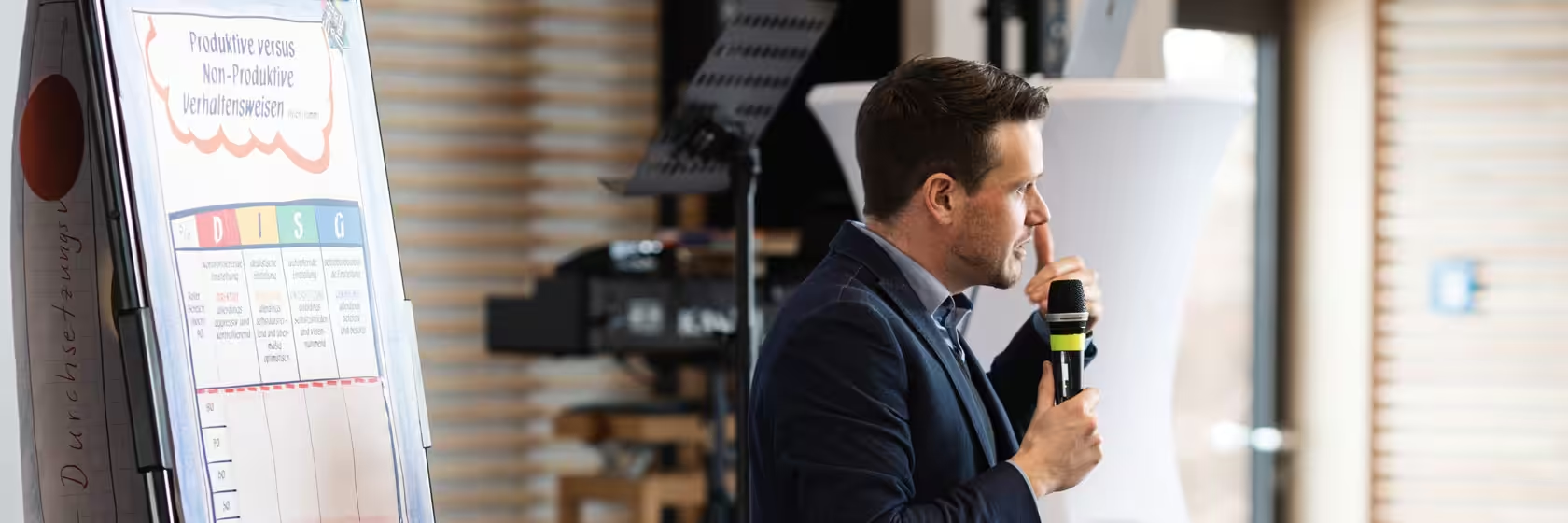
persolog® Personality Factor Model
The persolog® Personality Factor Model describes human behavior based on four behavioral dimensions: Dominant (D), Influencing (I), Steady (S), and Cautious (C). It helps you better understand your own behavior and the behavior of others, recognize differences, and work more effectively with different behavioral preferences.
Whether in teams, leadership, coaching, or change processes, the model provides a common language for reflecting on behavior, identifying individual strengths, and improving collaboration with others.
What is the persolog® Personality Factor Model?
The persolog® Personality Factor Model helps you understand how people behave in different situations and how behavioral preferences influence interactions with others. Rather than defining fixed personality types, it considers the individual combination and intensity of four behavioral dimensions: Dominant (D), Influencing (I), Steady (S), and Cautious (C).
This approach supports self-reflection and provides a common language for discussing behavioral differences. It can be applied in areas such as communication, teamwork, leadership, team development, personnel development, and change processes.
The four behavioral dimensions D, I, S, and C
The persolog® Personality Factor Model distinguishes between four fundamental behavioral dimensions: Dominant (D), Influencing (I), Steady (S), and Cautious (C). They describe different behavioral tendencies and help you better understand both your own behavior and the behavior of others.
Dominant
Dominant behavior is often direct, decisive, and results-oriented.
People with a stronger preference for this behavioral dimension often approach challenges proactively, like to make decisions, and focus on achieving results.

Influencing
Influencing behavior is often sociable, open, and enthusiastic.
People with a stronger preference for this behavioral dimension often seek interaction with others, contribute ideas, and enjoy inspiring people.

Steady
Steady behavior is often patient, supportive, and reliable.
People with a stronger preference for this behavioral dimension often value cooperation, stable relationships, and an environment built on trust.

Cautious
Cautious behavior is often analytical, careful, and quality-oriented.
People with a stronger preference for this behavioral dimension often pay close attention to details, examine information carefully, and value clear structures and standards.
Beyond fixed personality types: behavior depends on the situation
The persolog® Personality Factor Model does not assign people rigidly to one of four personality types. The four behavioral dimensions Dominant, Influencing, Steady, and Cautious can vary in intensity and may be expressed differently depending on the situation and environment.
D, I, S, and C are therefore not intended to put people into boxes or classify behavior as “good” or “bad.” Instead, the model provides a common language for describing, reflecting on, and better understanding different behaviors.
Different behavioral preferences can bring different strengths and challenges depending on the situation. The goal is not to conform to a particular dimension, but to become more aware of your own behavioral preferences and understand how your behavior may affect others.
Where is the persolog® Personality Factor Model used?
The persolog® Personality Factor Model can be used wherever people want to reflect on their own behavior and collaborate more consciously with others. Typical areas of application include team development, leadership, personnel development, change management, training, and coaching.
Improve teamwork and communication
People can perceive the same situation differently and respond to it in different ways. Understanding the four behavioral dimensions helps teams recognize these differences, communicate more consciously, and address potential conflicts at an early stage.
Adapt leadership to different people
Leaders work with people who have different needs and behavioral preferences. The persolog® Personality Factor Model helps leaders reflect on their own leadership behavior, become more aware of their impact on others, and adapt their approach to different employees.
Identify strengths and development opportunities
Reflecting on your own behavioral preferences can help you become more aware of personal strengths and areas for development. These insights can support both personal development and personnel or leadership development.
Navigate change more consciously
People respond to change in different ways. Understanding different behavioral preferences can help you interpret these reactions more effectively and adapt communication during change processes accordingly.
Use the persolog® Personality Factor Model in training and coaching
Trainers and coaches can use the persolog® Personality Factor Model to encourage self-reflection and explore different behavioral preferences with participants or coachees. The model can be applied in areas such as team development, leadership development, communication, and change processes.
Support personnel and organizational development
Organizations can use the persolog® Personality Factor Model in various areas of personnel and organizational development. A shared language for behavior can make differences easier to recognize and discuss, helping people collaborate more consciously.
How is the persolog® Personality Factor Model applied in practice?
The persolog® Personality Factor Model is put into practice through a range of profiles, strategy planners, quick checks, and learning and training tools. Depending on the objective, these instruments help individuals, trainers, coaches, leaders, and organizations explore specific aspects of behavior in greater depth.
Reflect on behavior and personality
The persolog® Behavior Profile and the persolog® Personality Profile offer different levels of depth for exploring individual behavioral preferences. While the Behavior Profile covers interpretation levels 1 and 2, the more comprehensive Personality Profile covers all seven interpretation levels of the Personality Factor Model and can be used, for example, in coaching or more extensive training programs.
For a more compact introduction, tools such as the Behavior Short Profile and Behavior Quick Check are also available.
Explore behavior in different professional contexts
Specific profiles allow the behavioral dimensions to be explored in relation to particular professional roles. The persolog® Leadership Profile, for example, focuses on leadership behavior, while the persolog® Sales Profile focuses on behavior in sales.
Apply D, I, S, and C to specific challenges
Additional tools transfer the principles of the Personality Factor Model to specific challenges, including sales and service, change processes, time management, learning, stress management, and teamwork. This makes it possible to apply insights about behavioral preferences to a range of everyday professional situations.
Work professionally with the persolog® Personality Factor Model
If you want to use the persolog® Personality Factor Model professionally in training, coaching, personnel development, or leadership development, you can become certified in the model. During the certification program, you explore the four behavioral dimensions D, I, S, and C in greater depth and learn how to use the model and its associated tools in your professional work.
Who is the certification for?
The certification is designed for professionals who support the development of other people. This includes trainers, coaches, leaders, personnel development professionals, and HR professionals who want to use the Personality Factor Model in their professional context.
What can you use after completing the certification?
The certification provides the foundation for working professionally with the persolog® Personality Factor Model and its associated profiles and materials. You can integrate the model into training programs, coaching sessions, workshops, and personnel or leadership development initiatives.
Experiences with the persolog® Personality Factor Model
The certification has provided us with a tool that supports us in many ways - from the selection and development of employees and the composition of teams to customer care. The investment has paid off.
Robin Heintze, Managing Director morefire
The persolog® Personality Factor Model is an integral part of our success due to its simplicity and flexibility in application. Persolog, together with its professional team, has been a loyal companion of our academy for years.
Markus Boxleitner, Managing Director of Dreiflüsse Akademie
The certification as a persolog® personality trainer was one of the best trainings I have participated in so far. Starting with the organization in the run-up, to the many details over the course of the 3 days, to the great trainer's kit and all the trainer documents and materials worked out down to the last detail and ready for immediate use.
Sandy Steinert, Human Resources Development, Heinrich Schmid GmbH & Co. KG
Frequently asked questions about the persolog® Personality Factor Model
What is the difference between personality and behavior?
Personality encompasses various characteristics and traits of a person, while behavior describes how a person acts in particular situations. The persolog® Personality Factor Model focuses on behavioral preferences and takes into account that behavior can be expressed differently depending on the situation and environment.
Is the persolog® Personality Factor Model a personality test?
The persolog® Personality Factor Model is a model for reflecting on and describing behavior rather than assigning people to fixed personality types. Different profiles based on the model can be used to explore individual behavioral preferences and provide a structured basis for self-reflection and development.
How can I find out which behavioral preferences are strongest for me?
Profiles based on the persolog® Personality Factor Model allow you to explore and reflect on your individual behavioral preferences in a structured way. Different tools are available depending on the level of depth and the specific objective, including the persolog® Behavior Profile and the more comprehensive persolog® Personality Profile.
Which persolog® profile is suitable for which purpose?
The right persolog® profile depends on the question you want to explore and the context in which you want to use the results. The Behavior Profile and Personality Profile focus on behavioral preferences at different levels of depth, while profiles such as the Leadership Profile and Sales Profile apply the model to specific professional contexts.
How should the results of a persolog® profile be interpreted?
The results of a persolog® profile should be understood as a basis for reflecting on behavioral preferences rather than as a fixed assessment of a person. They can help you recognize patterns, strengths, and potential challenges and consider how your behavior may vary across different situations and contexts.
Can the persolog® Personality Factor Model be used without certification?
The persolog® Personality Factor Model can also be used for personal reflection and development without professional certification, for example through suitable learning resources and applications. Certification is relevant if you want to work professionally with the model, its profiles, and associated materials in areas such as training, coaching, or personnel development.
How can the persolog® Personality Factor Model help with team conflicts?
The persolog® Personality Factor Model can help team members better understand different behavioral preferences and reactions. This can make it easier to discuss differences in communication and teamwork and reflect on possible causes of misunderstandings. The model does not resolve conflicts automatically, but it can provide a common language for discussing different behaviors constructively.