
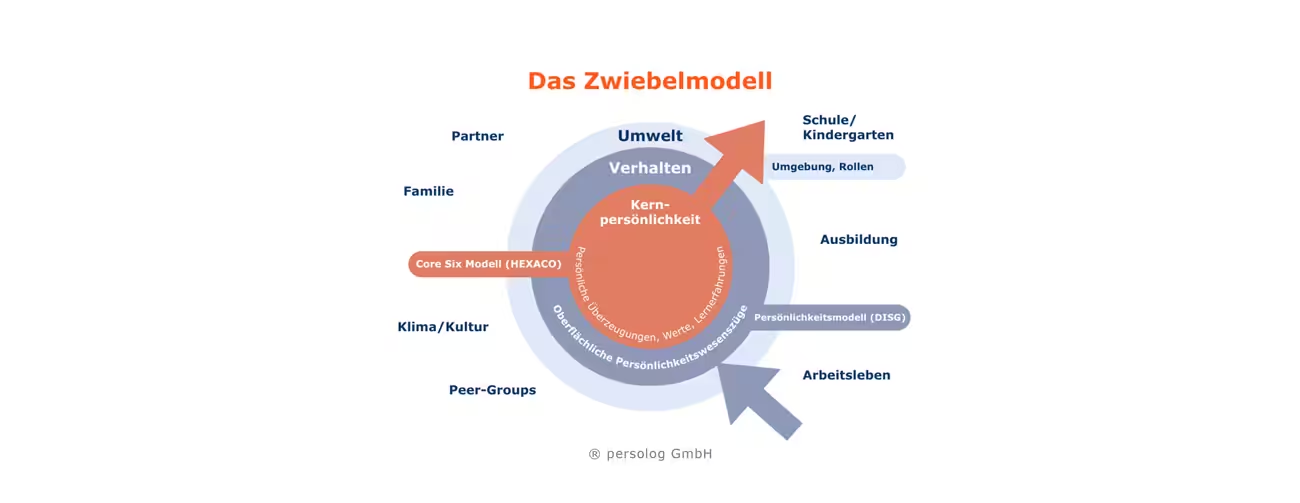
Many of us have been working successfully with DISC for years. For good reason: DISC makes our own behavior more visible, facilitates communication and teamwork, and helps people who want to grow get started immediately with a quick impact.
At the same time, the same gaps keep appearing in training sessions, coaching, and HR processes:
• WHY does someone display a particular behavior?
• WHY does behavioral flexibility work easily in one situation but not at all in another?
• WHY do conflicts escalate even though everyone is “technically” communicating professionally?
At this point, it is helpful to go one level deeper: moving away from simply observing behavior toward understanding core personality. This is exactly where persolog® CORE SIX comes into play.
Based on the internationally recognized HEXACO model of personality, persolog® CORE SIX reflects the current state of research while being ideally suited for highly effective practical application.
DISC and HEXACO Answer Different Questions
The most common mistake is to pit the two models against each other. This is neither theoretically justified nor practically useful.
The DISC model is a behavioral model. It describes observable behavior in specific situations.
The HEXACO model of personality is a personality model at the trait level. It describes relatively stable personality characteristics that are inherent in a person. This allows persolog® CORE SIX not only to make behavioral patterns visible, but also to explain them.
A practical rule of thumb:
• DISC: “HOW do I behave?”
• HEXACO: “WHY do I behave this way?”
Why DISC Alone Is Sometimes Not Enough Despite Its Strengths
DISC is powerful in situations where you need quickly applicable and smoothly working levers to:
• improve communication
• structure collaboration
• reflect on behavior in leadership, sales, or conflicts
• train behavioral flexibility
But behavior exists at the surface level of human personality.
When people repeatedly reach their limits, when conflicts keep recurring, or when leadership appears “technically correct” but does not resonate with the team, something is often at play that DISC does not directly capture: the so-called traits of core personality, which influence not only how people behave, but also how they think and feel.
This is where the questionnaire of the HEXACO model of personality (HEXACO-PI-R) provides clear guidance. It measures an individual’s personal expression across six different scales. These scales correspond to the six factors identified in personality psychology as key parameters for capturing and understanding core personality. With persolog® CORE SIX, the original questionnaire has been embedded into a practical training tool that makes evaluation and analysis accessible and discussable.
HEXACO therefore not only provides insight into better understanding one’s own and others’ thinking, feeling, and behavior. More importantly, a person’s position across the six scales offers valuable guidance on how they can better use, apply, and manage the traits associated with their core personality.
The Factor That HEXACO Brings into the Equation
With HEXACO as its scientific foundation, persolog® CORE SIX is the tool that translates this foundation into the context of diagnostics, HR, coaching, and development. Both models work with six factors that are considered key determinants of human core personality in psychology.
These factors are:
- Honesty and Humility
- Emotionality
- Extraversion
- Agreeableness
- Conscientiousness
- Openness to Experience
For many professionals, the key point is this: with Honesty and Humility, HEXACO introduces a factor that is not included in the classic Big Five. As a result, HEXACO and persolog® CORE SIX specifically capture aspects of human personality that play an important role in many contexts, especially in environments shaped by truly effective leadership.
Explaining Behavior Without Stigmatizing People
The goal is not to evaluate which model is “better.” What matters more is how to combine DISC on the one hand and HEXACO on the other in a way that enables development.
The following approach has proven effective:
1) Start with DISC (external perspective)
• What behavior does a person show in a specific situation?
• How do they come across to others?
• What are their typical reaction patterns under pressure?
2) Deepen with HEXACO / CORE SIX (internal perspective)
• Which core personality traits underlie the person’s behavior?
• What internal and external tensions does the person experience within the team, in leadership, or in their role?
• What works well in principle but still costs the person a lot of energy?
3) Concrete development work
• Which development goals are realistic? What behavior or trait is being targeted?
• Where is it necessary to shape the context rather than work on oneself?
• How can the person deal more effectively with traits that consistently create challenges?
In short: DISC remains the action-oriented tool. HEXACO provides the explanatory layer and opens up deeper perspectives when observing behavior alone is no longer sufficient.
A Typical Insight: Warm, Friendly, and Unyielding
An example from practice:
A person appears warm, friendly, and approachable. In conflict, they remain calm. And yet, they do not give in. Others experience this as contradictory, sometimes even as rigidity.
At the behavioral level (DISC), you see a calm, friendly, and controlled individual who clearly stands by their opinion. At the trait level (HEXACO), the following conclusions can be drawn:
• The person is likely to score high on traits such as gentleness and forgiveness, both facets of Agreeableness.
• At the same time, the person is likely to score low on willingness to compromise, also a facet of Agreeableness.
• The result of this combination: friendly in interaction, yet clear in setting boundaries.
These observations and conclusions are not diagnoses. They are hypotheses that can be strengthened using the DISC-based persolog® behavioral profile and the HEXACO-based persolog® CORE SIX profile, opening the door for self-reflection:
• Where is your boundary and when do you communicate it?
• Why do others often recognize your boundary only quite late?
• How could you make your boundaries more visible without losing likability?
The starting point of these questions lies in the hypotheses. The starting point of the answers lies within the individual and their desire for growth.
Coaching, Leadership, HR: Where HEXACO Is Especially Powerful
HEXACO becomes particularly valuable when you want to support development processes at the level of core personality.
1) Coaching and Needs-Analysis
HEXACO enables a deeper view into personality:
• What drives the person?
• What challenges them?
• Why do recurring patterns of internal and external conflict emerge?
2) Long-term Leadership Development
HEXACO allows differentiated work on topics such as:
• impact within the team
• decision-making logic and responsibility
• alignment with organizational culture
3) Recruiting and Diagnostics
In recruiting processes, the HEXACO-based persolog® CORE SIX profile helps identify relatively stable personality traits and align them with the requirements of a specific role.
HEXACO Is Not a Model You Master in Half a Day
HEXACO as a workshop tool you fully grasp in half a day? No. Anyone who wants to use HEXACO or CORE SIX needs to adjust that expectation.
A model that …
• captures personality in a differentiated way,
• enables deep self-reflection, and
• initiates real development work
… comes with a certain level of complexity. However, thanks to its consistent logic, this complexity can be understood without difficulty.
Conclusion: DISC Is the Entry Point, HEXACO Provides the Depth
If DISC makes your work faster, clearer, and more action-oriented, you should absolutely stick with it.
And if you notice that behavior alone does not explain why people repeatedly struggle with themselves, fail at the same points, or lose energy, then HEXACO enables you to look at the core personality traits that likely drive these patterns.
HEXACO is not a replacement for DISC. Rather, it allows you to expand your toolkit with a model that is both scientifically grounded and highly practical, and for that reason, it will soon become indispensable in training and coaching contexts.